
Dublin Castle Project
Master-Class Stone Restoration for Historic Buildings

The Dublin Castle project is a great example of how traditional materials and extensive restoration knowledge can work together.
Roman lime mortars can provide the combination of compatibility, breathability, flexibility and durability needed for demanding historic restoration work.
Most importantly, the goal isn’t to hide the building’s age. It’s to repair the damage while allowing the original character to remain visible.
We had the privilege of being involved in the restoration of Dublin Castle during preparations for Ireland’s Presidency of the Council of the European Union.
Alongside more general lime rendering work, we were involved in some of the more specialised restoration, particularly the carved stone balustrades.
These balustrades had been carved from relatively soft stone and had suffered cracking, breakage and missing sections over the years. Some previous repairs had also been carried out using cement, which is considerably harder and less compatible with the softer stone and can contribute to accelerated erosion.
The solution was to remove the old cement repairs and rebuild the damaged areas using compatible Roman lime mortars.


Why compatibility matters in stone restoration
When restoring historic stone, the strongest material isn’t necessarily the best material.
The repair mortar needs to work with the original stone. Breathability, flexibility, adhesion and weathering characteristics all matter.
This was particularly relevant at Dublin Castle, where Roman lime mortars had historically been used. The restoration team was therefore specifically looking for Roman lime products that would provide the necessary performance while remaining compatible with the existing materials.
However, the same approach can be valuable for many historic buildings, even where Roman lime wasn’t originally used.

Rebuilding the damaged stone with Betoncino Consolidante
Betoncino Consolidante is particularly well suited to this type of restoration because it combines excellent adhesion, flexibility and vapour permeability with significantly greater mechanical strength than conventional lime mortars.
One of the key principles of successful stonework conservation is material compatibility. A repair material should have physical and mechanical properties as close as possible to those of the original stone. In this case, the mortar has properties that are well suited to the original sandstone, including comparable vapour permeability, flexibility and mechanical characteristics.
The closer the repair material is to the original substrate in these respects, the more compatible and durable the restoration is likely to be.
These distinctive properties are rooted in an important aspect of traditional Roman lime technology: the use of volcanic pozzolans.
After removing the previous cement repairs, all loose and friable material was carefully removed, and the exposed stonework was thoroughly wire-brushed to prepare the surfaces for repair.
The stone was then thoroughly dampened before applying Betoncino Consolidante MGN, a structural-grade Roman lime mortar. The mortar was used to fill larger gaps and voids, replace areas of missing stone and reconstruct the overall form of the damaged balustrades.
Why volcanic pozzolans matter
This makes these mortars particularly useful for exposed external stonework, where a very soft lime mortar may weather away too quickly.
Roman lime technology has a very useful characteristic: the addition of volcanic pozzolans can significantly enhance the performance of lime mortars, improving their strength, durability and resistance while maintaining breathability and other characteristics that make lime-based materials particularly suitable for historic masonry.
The volcanic material contributes reactive silicates and aluminates to the lime reaction, creating stronger chemical bonds. At the same time, the porous nature of the volcanic aggregate helps maintain a highly porous structure.
Creating the finished stone surface with Rasante B2007
Once the larger missing areas had been rebuilt, Rasante B2007 was used as the fine finishing and levelling layer.
This external lime mortar has a very fine grain and provides good mechanical resistance while remaining breathable and flexible.It was applied to create a uniform surface over the repaired sections. Once it had become fairly dry but had not completely hardened, the surface could be sanded and shaped to reproduce the desired forms and textures.
This is an important part of the process.
The aim isn’t simply to cover the repair. The objective is to make the repaired section feel and look like part of the original stonework.
Keeping the character of an old building
One of the most important decisions on the Dublin Castle project was not to make the restored stonework look perfect.
The client wanted to retain some of the imperfections and visible weathering.
That meant avoiding perfectly sharp corners and an unnaturally smooth finish. After all, this is a several-hundred-year-old building, and the original stonework wasn’t perfectly uniform either.
Good restoration should give an old building back its integrity without removing its history.
The final stage was to apply several coats of external mineral paint, giving the stonework a consistent colour while retaining the traditional appearance.

The Dublin Castle restoration process
In simple terms, the process was:
1.
Remove previous cement repairs and loose material.
2.
Clean and wire-brush the stonework where necessary.
3.
Dampen the stone before applying fresh lime mortar.
4.
Use Betoncino Consolidante to rebuild larger gaps, holes and missing sections.
5.
Apply Rasante B2007 as the fine finishing layer.
6.
Sand and shape the surface once sufficiently dry to reproduce the required texture and form.
7.
Allow the repair to fully set.
8.
Finish with external mineral paint for a uniform stone appearance.
Where can this technique be used?
The same basic approach can be used for many types of historic stone restoration, including:
- Stone columns and pillars
- Carved stone cornices
- Stone balustrades
- Damaged coping stones
- Carved architectural details
- Stone facades
- Damaged masonry and historic walls
- Areas where sections of stone are missing
The exact specification will depend on the original stone, the extent of the damage and the exposure of the building. But the fundamental principle remains the same:
Choose a repair material that is compatible with the original building.
Restoring stone for the future
That's what good restoration should do: preserve the history while giving the building many more years of life.
CLICK ON THE PRODUCTS FOR MORE INFORMATION
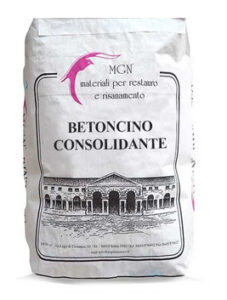
Betoncino Consolidante MGN
A high-compression, breathable lime mortar. Flexible, strong, and based on ancient "Roman Concrete" Ideal for seismic reinforcement and structural consolidation in heritage structures

Rasante B2007
Protective lime finish to provide mechanical resistance to renders for weatherproof external use.
Tell us about your project!
If you’re working on damaged historic stonework, old cement repairs or missing carved architectural details, our experienced team can help you identify a suitable lime repair system for the project.